Let’s say you have one big budget and two big channels to spend it on. TikTok ads could put you in front of new buyers, but only if you can keep making fresh video. Facebook ads feel safer, but you may be missing the next wave of customers.
For ecommerce brands, neither platform wins for every store all the time. Your choice may ultimately come down to a few things, so we’ll help you sort it out.
Below, you'll find cost data for TikTok ads vs. Facebook ads, six differences that affect which channel fits your ecommerce business, and a simple test to see which will pay off most.
Key Takeaways
- TikTok ads are paid videos in the TikTok app. Facebook ads are Meta ads that run on Facebook and often on Instagram, with more ad formats. In our data, TikTok cost less to run, while Facebook returned more revenue per ad dollar.
- If you’re new to paid ads, start with the platform where you can make fresh ads each week and track sales clearly. If you already run ads, choose your next test by profit per new customer, then run one fair test with a goal set before launch.
- Triple Whale Attribution shows TikTok and Meta results in one reporting view, including new-customer ROAS (revenue per ad dollar) and CPA (cost per purchase), so you don’t rely only on each platform's own reports.
What are TikTok Ads?
TikTok ads are short paid videos that brands run on TikTok. Most show up in and around the main feed, where people watch one short video after another.

The two most common types of TikTok ads are In-Feed ads and TopView ads:
- In-Feed ads: These are ads that play between regular videos.
- TopView ads: These are ads that are the first thing people see when they open the TikTok app.
Both can reach a large audience and drive views and reactions, so small shops and large brands use them.
Brands that want to stand out can try Branded Effects and Branded Hashtag Challenges. Effects are custom filters that people add to their own videos, and Challenges invite people to post videos around a theme. Both aim to get people to take part and spread your brand further.
Advantages of TikTok ads
What are the advantages of TikTok ads?
- Youthful audience. TikTok users skew young and energetic. If your target audience is Gen Z or Millennials, you’re in the right place. About 66% of TikTok’s global audience is aged 18 to 34, according to DataReportal.
- Engaging creativity. TikTok's short video format encourages creativity. You can tell a story and entertain your audience in a few seconds, which makes it a fun and effective place to advertise.
- Cost-effective reach. TikTok often offers budget-friendly CPMs, giving you a good deal on reaching a large audience. In our benchmarks below, TikTok’s median CPM was $4.07, compared with $15.48 for Meta.
- Influencer marketing. Creators are a big part of TikTok. You can team up with them to make content that fits your brand's values and style.
Disadvantages of TikTok ads
But here are the downsides of TikTok ads:
- Limited audience diversity. TikTok's user base skews younger. If you're targeting an older crowd, you may need to look elsewhere.
- Creativity requirements. Success on TikTok depends heavily on creative content. If you can't keep making fresh video, it's hard to get noticed here.
- Attribution challenges. TikTok currently offers limited attribution windows, which makes it harder to measure what your campaigns deliver.
- Ad budget requirements. TikTok ads can be cost-effective, but some programs and features may have minimum budgets that are steep for some businesses.
What are Facebook ads?
Facebook ads are paid promotions that brands place across Meta’s apps, including Instagram. They appear in Facebook and Instagram feeds, Stories, and Reels.

Facebook offers many paid ad formats, including single-image ads. Video ads add motion and sound. Carousel ads let people swipe through several photos or products in one ad.
Collection ads pair one big image or video with a row of products people can tap. Advantage+ ads use Meta’s automation to find shoppers who are likely to buy.Targeting is where Facebook stands out. Meta knows a lot about what people like and follow, so you can target narrow groups, such as people who love running.
Advantages of Facebook ads
Here are the pros of Facebook ads:
- Extensive user base. Facebook’s user base spans generations and demographics. You can usually find the people you want to target here.
- Advanced targeting options. Facebook's targeting tools are detailed. You can narrow your audience by age, interests, location, and even behaviors, so you reach the right people at the right time.
- Proven ROI. Many businesses see a strong return on investment (ROI) from Facebook ads, which makes it a favorite among advertisers.
- Conversion tracking. Facebook offers in-depth conversion tracking tools. You can see how your ad campaigns are performing and measure their impact on your goals.
Disadvantages of Facebook ads
Now, the drawbacks of Facebook ads:
- Increasing costs. The popularity of Facebook Ads has driven costs up over time. It's become the high-end boutique of advertising. That can be hard on smaller businesses with limited budgets.
- Ad fatigue. People on Facebook have seen a lot of ads. This can lead to "ad fatigue," where your audience responds less to your messages.
- Complex ad policies. Facebook also has strict ad policies. If you don't follow the rules, Facebook can reject your ads, and it can ban your account.
- Privacy concerns. Privacy concerns and changes in ad targeting options may limit your ability to reach specific audiences as easily as before.
TikTok ads vs. Facebook ads: Head-to-head comparison
When choosing TikTok vs Meta ads, there’s no universal winner. Start with your numbers to see which has performed better for you in the past.
TikTok is a good first test if you can film creator-style video often and want a lower reported cost per purchase, while Meta can be worth it if it already hits your margin targets or you want to use customer lists.
| Decision area | TikTok ads | Meta (Facebook) ads | What to test |
|---|---|---|---|
| Audience fit | Check TikTok’s reach estimate for your country and date. | Check Meta’s reach estimate for the same country and date. | Compare each channel’s buyers with your own customer mix. Run the same offer on both. |
| Formats | Native, vertical video that looks like a creator post | Video and images across Facebook and other Meta placements. | Adapt one product message to each placement. Compare cost per new customer. |
| Automation | Smart+Web is TikTok’s automated campaign type for website sales. | Advantage+ sales campaigns are Meta’s automation option for sales. | Run one automated campaign and one manual campaign. Note which controls your account shows. |
| Cost | CPM: $4.07 and CPA: $16.33* | CPM: $15.48 and CPA: $39.46* | Compare each cost with your own break-even CPA, not with the other channel’s median. |
| Purchase economics | ROAS: 1.47* | ROAS: 1.88* | Set a target CPA or new-customer CAC from your margin before you launch. |
| Measurement | Own pixel, events, and attribution window. | Own pixel, events, and attribution window. | Use one purchase definition and one reporting view. Both platforms may claim the same sale. |
What current benchmarks tell us about Facebook vs TikTok ads cost
Cheap reach doesn’t guarantee a profitable sale. Two numbers show whether a channel pays off: what you spend to get one purchase and how much revenue each ad dollar brings back.
Here’s how TikTok and Meta compare side by side for CPM, CPA, and ROAS.
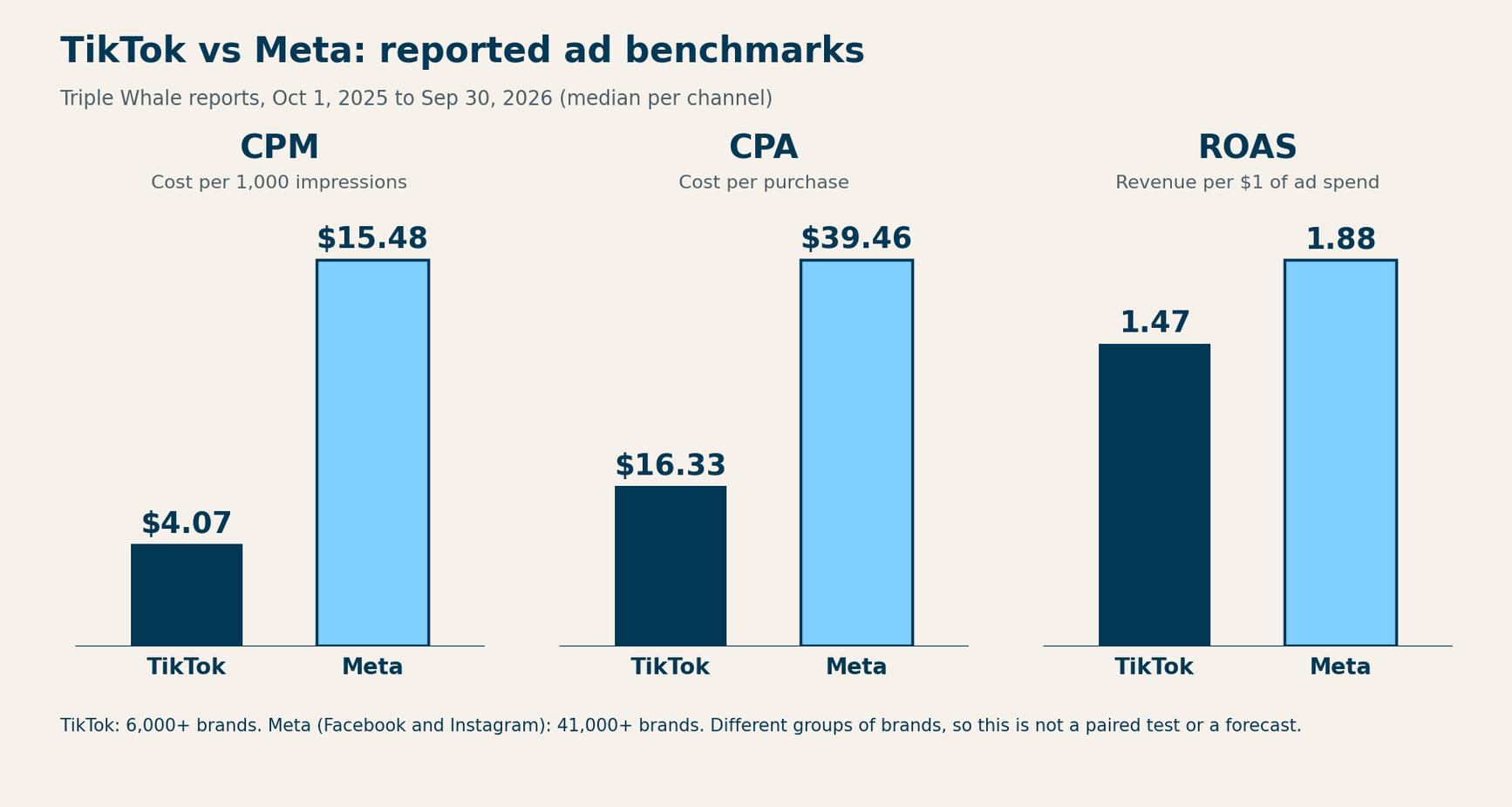
Compared with the year before, TikTok got cheaper for both reach and purchases, while Facebook ads got a little more expensive. Revenue per ad dollar barely moved on either platform.
Compare profitability, not only CPM or CPC
Four metrics show how TikTok Ads vs. Facebook Ads compare: CPM, CPC, CTR, and CVR.
CPM (Cost per mille)
CPM is what it costs to show your ad 1,000 times. Think of it as the price of getting your ad seen. A lower CPM means cheaper reach, but it doesn’t mean cheaper sales.
CPM = (Total Cost of Campaign / Total Impressions) * 1,000
- TikTok: TikTok ad costs move with who you want to reach, how many other brands want them too, and how strong your ad is.
- Facebook: Facebook ads cost more per impression, so its CPM tends to be heftier. It has an enormous user base and ad space, and it costs a bit more if you’re targeting a niche audience.
CPC (Cost per click)
CPC is what you pay each time someone clicks on your ad. A lower CPC is cheaper per click, but only if you compare the same click type, such as all clicks or link clicks.
CPC = Total Cost / Number of Clicks
- TikTok: TikTok often offers a lower CPC, making it budget-friendly if you want people to click through to your website.
- Facebook: Facebook's CPC can be higher, but it can be worth it if those clicks lead to customer acquisition and make your investment pay off.
CTR (Click-through rate)
CTR tells you how many people actually clicked on your ad after seeing it. It also indicates how engaging an ad is to the audience. A high CTR only helps if those clicks turn into purchases.
CTR = (Total Clicks / Total Impressions) * 100
- TikTok: TikTok's CTR can be pretty competitive since eye-catching short-form videos drive clicks.
- Facebook: Facebook's CTR can fluctuate as it depends on the audience, placement, and the creative.
CVR (Conversion rate)
Conversion rate (CVR) measures the percentage of people who took the desired action after clicking your ad. In simple terms, it shows how well your ad turns clicks into actions, like making a purchase, signing up, or whatever you want your audience to do. The higher the conversion rate, the better your ad's doing.
CVR = (Number of Conversions / Number of Clicks) * 100
- TikTok: When it comes to CVR, TikTok can work well for some brands. Its younger, more engaged audience may mean higher CVR for certain brands, especially if they resonate with the TikTok crowd.
- Facebook: Facebook's CVR is generally higher, especially for e-commerce businesses. This might be because it has a more mature user base with established shopping behaviors.
These metrics show which platform fits your specific goals. TikTok could be your budget-friendly option, while Facebook might bring in higher-quality clicks.
Six differences that change your channel decision
A cost chart only tells part of the story. These six differences decide which channel fits your brand. Each one ends with a small test, so you can find out for yourself instead of guessing.
1. Audience fit and purchase intent
Think about your best customer on a slow Tuesday night. Are they scrolling short videos, or catching up on Facebook and Instagram? Don’t assume TikTok is only for young people, or that Meta reaches everyone.
Both ad tools show reach estimates. Check yours for your country and write down the date. Then compare it with your own customers by location and first product bought. A reach estimate counts people you might reach, but it can’t tell you who will buy.
Test it: Run the same offer on both, then compare the customers you win, not just the clicks.
2. Creative formats and production capacity
TikTok is built for entertainment, so your ad has to earn attention in the first few seconds. Lo-fi video, user-generated content (UGC), and creator collabs tend to fit. Meta handles UGC too, and it still supports classic direct response ads, especially for remarketing.
Take one message: “This blender makes a smoothie in 30 seconds.” On TikTok, a creator films it in one take, blender in hand. On Meta, the same claim can run as a short Reel, or as a clean image with the offer on screen.
Volume is the catch. People tune out an ad they’ve seen too many times. So make sure you have time and budget for new creative.
Test it: Make one native version of the same message for each platform, then compare cost per new customer.
3. Targeted and automated campaigns
You can steer the audience yourself, or let automation do more of the work. Both platforms offer both, and the controls you see depend on your account.
For manual control, Meta has long offered detailed audience tools, including interest targeting, lookalike audiences, and retargeting. TikTok targets by interest and behavior. Even inside Smart+ Web, its help page lists controls such as location, language, exclusions, and limited gender targeting.
For automation, Meta's Advantage+ sales campaigns handle many audience, placement, and budget choices. TikTok's Smart+ Web handles much of the setup for website sales campaigns. On either platform, the more you automate, the more your creative and clean conversion data matter.
Privacy rules and updates can limit targeting, so check which options your account shows today.
Test it: Run one automated campaign and one manual campaign on the same offer, and note which controls your account offers.
4. Acquisition, retargeting, and customer quality
Say a channel shows a great CPA. Then you learn half those buyers had already ordered from you. That isn’t growth. You paid to reach people you already had.
Retargeting makes this easy to miss. It reaches people who already visited or bought, so its numbers can look strong without adding a single new customer. Compare channels on the same objective, and pick one definition of “new customer” for both. Neither platform only finds new buyers or only wins back old ones, so don’t give all discovery to TikTok and all conversion to Meta.
Track three numbers for each channel: new-customer CAC, first-order AOV (average order value), and the share of purchases from returning customers.
Test it: Report new customers and CAC by channel, using one definition of “new.”
5. Budget and learning requirements
Plan for three costs: the platform minimum, enough spend to see results, and the creative itself. Our proprietary data showed that Meta’s reported CPM and CPA were higher than TikTok’s from October 1, 2025 to September 30, 2026. That can sting a small budget. A higher cost per purchase can still pay off if the customer is worth more.
Platforms also need enough purchases to learn which ads work, so a very small test can give noisy results. Check each platform’s current learning guidance for your objective.
Start from your target CPA. Say it’s $20 and you want to see 30 purchases. Plan about $600 in ad spend, plus creative cost. This is just an example, not a rule, so skip any fixed daily number or fixed split.
Some programs, such as creator programs, set their own minimum budgets. That’s a program rule. Verify exact minimums for your objective, region, and account before you quote one.
Test it: Set the budget from your target CPA and the number of purchases you need to see.
6. Measurement and attribution
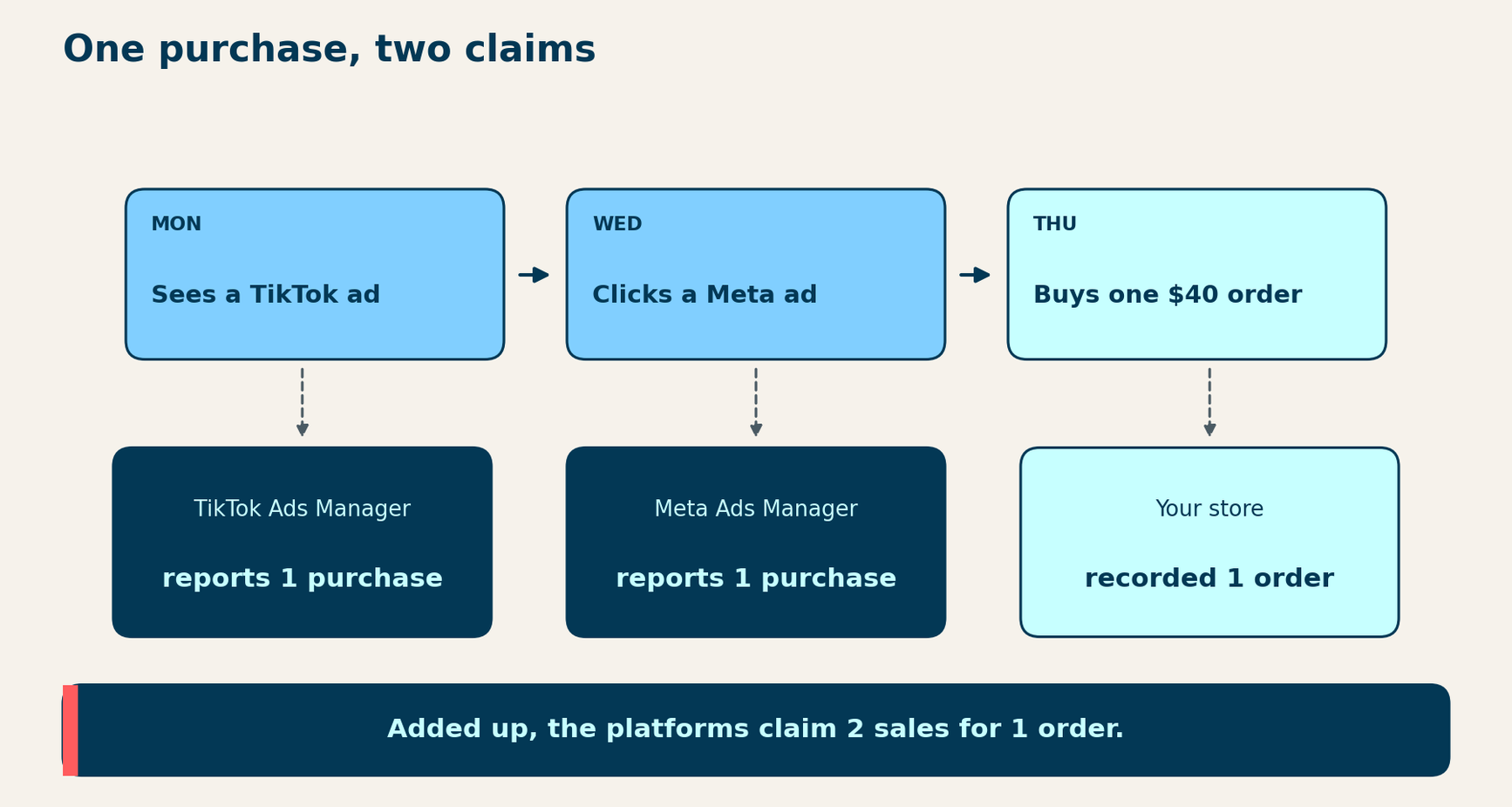
Each platform uses its own attribution window, and the options have changed over time. Each has its own pixel, server-side events, and reports. So when you compare TikTok Ads Manager vs. Facebook Ads Manager, check the window and click/view settings in each account.
Here’s why this matters. A shopper can see a TikTok ad, click a Meta ad, and buy once. Both platforms report that sale. Each one takes credit, so their reports alone can’t tell you which channel is doing better.
Set up events on both, making sure purchases aren’t counted twice, and note the window before you compare. Each platform’s tools only report what that platform can see.
TikTok ads vs. Meta ads for ecommerce: Which should you choose?
The honest answer depends on your goal. Choose TikTok ads if you want low-cost reach to new buyers and can make creator-style video often. Consider Meta ads if you want steady, trackable sales and more ad formats to work with.
| Feature | TikTok ads | Meta ads |
|---|---|---|
| Best for | Reaching new buyers with creator-style video | Steady sales, retargeting, and customer lists |
| Audience | Skews younger, including Gen Z and millennials | Spans generations and demographics |
| Ad formats | Native, vertical video | Video, images, carousels, collection ads, Stories, and Reels |
| Cost Metrics (CPM/CPC) | Generally cheaper initial CPM and CPC | Typically higher CPM and CPC |
| Creative Demand | Needs a steady flow of fresh video | Supports UGC and classic direct response ads, but ad fatigue still applies |
Many growing ecommerce brands use TikTok and Meta ads together. You can use TikTok to generate cheap top-of-funnel engagement and awareness, then retarget those engaged users on Meta to drive conversions.
Conclusion
So, TikTok or Facebook? There’s no right answer. Most ecommerce businesses use both. Start with the one that fits the creative you can make and the budget you have today. Add the other when you’re ready. You don’t have to pick a side forever.
Once both are running, you’ll want to know which one is really bringing in customers. That’s where Triple Whale comes in. It puts your TikTok ads, Meta ads, and store orders in one place, so you can compare each channel side by side.
Meta ads vs. TikTok ads: FAQs
Are Facebook ads better than TikTok ads?
Not in every case. Facebook ads vs TikTok ads comes down to your product, your creative, and your cost limit per new customer. In our proprietary data, Meta's reported ROAS was higher (1.88 vs 1.47), while TikTok's reported CPM and CPA were lower. The brand groups differ, so run your own tests.
Are TikTok ads worth it?
They can be, if the numbers work for you. In the same report window, TikTok's reported CPA was $16.33, and its reported ROAS was 1.47. Compare those with your own break-even CPA and the creative you can make. A small, capped test is the best way to find out.
Are TikTok ads more cost-effective than Facebook ads for small advertisers?
Our data for the reported time period shows that TikTok reported a lower CPM and CPA, but its reported ROAS was lower too. Cost-effectiveness depends on profit per order, not just the cost of reach. Small advertisers should also count what new videos cost to make. Test one channel at a time with a set limit.
How do TikTok ads compare to Facebook ads for ad performance?
Judge both with the same measures: new customers, CAC, AOV, and margin. That’s the fair way to compare Meta ads vs TikTok ads.
Can you use the same creative on TikTok and Facebook?
Sometimes. A strong idea, hook, or offer can move between platforms, but the look should change. TikTok favors native, vertical, creator-style video, while Meta supports more formats. Make a native version for each, and check current specs and usage rights.
Should an ecommerce brand run both TikTok and Meta ads?
Yes, if each channel can meet your CAC target and you can feed both with new creative. Don't assume TikTok handles discovery and Meta handles conversion. Report new customers and CAC for each channel, and carry learnings, such as a winning angle, from one to the other.