Eighty-four percent of ecommerce businesses rank AI as their top strategic priority. Chances are you're one of them.
Maybe you've just started leaning on AI. You've asked ChatGPT to summarize a report or draft an email, and it's fast enough to make you wonder: If a free chatbot can do this, what's a dedicated ecommerce AI tool actually for?
Or maybe you're past that. You've built out prompts and started running most of your reporting through AI.
But then two platforms disagree on last week's ROAS, and the number Claude gave you doesn't match what landed in the bank.
DIY-ing the stack works fine until the data has a discrepancy AI can't resolve. That isn’t a problem to sweep under the rug.
So, let’s talk about it.
This post is a feature-by-feature comparison of generic AI (i.e., ChatGPT, Claude, Gemini, Grok, and Deepseek) with the AI operating system Triple Whale and Moby AI, the intelligent core of Triple Whale.
Key Takeaways
- LLMs are flexible for copy, brainstorming, and drafts, but lack live business context and unified measurement.
- Triple Whale’s Moby AI layers the same frontier models with real-time ecommerce data, a Context Engine trained on ecommerce semantics and a Measurement Layer powered by Triple Pixel, enabling trusted answers with actions.
- Key differentiators: live order/ad data, reconciled attribution, ecommerce-native semantics, benchmarks from 60K+ brands and $82B+ GMV, and automation that executes changes in platforms.
What do we mean by "generic AI," anyway?
When we say generic AI, we mean generative AI. This type of artificial intelligence creates new content (such as text, images, video, audio, or code) based on patterns learned from large amounts of existing data.
It can draft emails, analyze information, generate creative ideas, and answer questions. Paid and professional plans may also provide access to more advanced models, higher usage limits, file analysis, web research, media generation, and integrations with other tools.
Large language models (LLMs) are a type of generative AI. They understand and generate language, allowing tools like ChatGPT, Claude, Gemini, Grok, and DeepSeek to answer questions and follow instructions in your everyday language.
Put simply: Generative AI is the broader category, while an LLM is the technology commonly used to generate and work with language.
Most brands already use LLMs like ChatGPT for ecommerce tasks like creative copy and market research. For more on this, check out ChatGPT for Ecommerce: Can OpenAI Run My Entire Business for Me?
But when it comes to what's happening inside the business right now, a general-purpose model only knows the information in its training data, the files connected to it, and whatever you typed into the conversation.
It doesn't automatically know whether yesterday's lower ROAS came from a creative issue, a shift in customer mix, rising acquisition costs, attribution overlap, or a reporting discrepancy.
That’s why ecommerce teams turn to AI operating systems like Triple Whale, powered by a robust data platform that includes comprehensive brand metrics, customer behavior insights, advertising performance data, and more.
That foundation powers Moby, the intelligent core of Triple Whale. You can chat with Moby like a teammate. Ask questions, uncover insights, create strategies, and take action across your business.
The best part? You don’t have to choose between your favorite AI tools.
Moby harnesses frontier models from Anthropic, OpenAI, and Google. You get the models you already know, now equipped with the connected business context and reconciled measurement needed to help you run your ecommerce business.
Speaking of LLMs, what models are out there?
Tools like ChatGPT, Claude, Gemini, Grok, and DeepSeek are the most common examples of LLMs. These companies build the foundation models that can write, reason, research, code, and create media.
Anthropic: Claude
Anthropic develops Claude, a family of models known for thoughtful analysis, natural writing, and the ability to work through detailed instructions and large amounts of information.
Claude is particularly useful when a task requires careful reasoning or clear communication. An ecommerce team might use it to analyze a long performance report, turn customer research into positioning, build a campaign plan, or explain why several metrics appear to be moving in opposite directions.
| Anthropic Model | What It Does Well | What Changes With Moby |
|---|---|---|
| Claude Opus | Complex reasoning, strategic planning, and detailed analysis | Can reason over live ecommerce data, prior decisions, targets, and connected business context |
| Claude Sonnet | Fast, balanced analysis, writing, and everyday operational work | Can turn current performance signals into reports, recommendations, and connected workflows |
| Claude Family | Summarization, document analysis, campaign planning, and clear long-form writing | Does not need the operator to re-explain the business and its core metrics in every prompt |
OpenAI: ChatGPT
OpenAI develops the GPT models behind ChatGPT. These models are popular because they can handle a broad mix of tasks, including writing, analysis, coding, brainstorming, image creation, and multi-step problem-solving.
Triple Whale has publicly made GPT models available natively in Moby, including GPT-5.5 and GPT-5.6 Sol. GPT-5.6 Sol has also served as Moby’s default model. Triple Whale’s creative workflows use GPT Image 2 for image generation.
| OpenAI Model | What It Does Well | What Changes With Moby |
|---|---|---|
| GPT-5.6 Sol | General reasoning, planning, analysis, and multi-step operational tasks | Works from Triple Whale’s current business context and can help move from a question to governed execution |
| GPT-5.5 | Ecommerce analysis, writing, workflow planning, and problem-solving | Can evaluate live performance without requiring a fresh CSV upload for every request |
| GPT Image 2 | Generating and editing marketing images | Can support creative workflows informed by brand context, product requirements, and campaign goals |
| ChatGPT/GPT Family | Flexible everyday AI work across writing, research, analysis, and ideation | Gains a trusted ecommerce data and measurement layer rather than depending only on pasted inputs |
Google: Gemini
Google’s Gemini models are built for multimodal work, meaning they can reason across formats such as text, images, documents, and other media. They are also useful for research, large-context analysis, and tasks that involve several kinds of information at once.
Moby uses Google’s Gemini family as part of its model-flexible stack. Triple Whale’s creative tooling also uses Google models for image and video generation, including Nano Banana and Veo.
| Google Model | What It Does Well | What Changes Inside Moby |
|---|---|---|
| Gemini | Multimodal reasoning, research, document analysis, and working across large amounts of information | Can analyze that information alongside current ecommerce metrics and business context |
| Nano Banana 2 | Fast image generation and visual iteration | Can be used in creative workflows shaped by the brand, product, and campaign objective |
| Nano Banana Pro | Higher-control image generation and refinement | Supports more detailed marketing visuals without separating creation from business context |
| Veo 3.1 | Cinematic AI video generation | Can help turn creative concepts into short video assets for ecommerce campaigns |
| Gemini Omni Flash | Fast multimodal generation and iterative media work | Supports conversational creative development and revision inside a broader workflow |
Grok: xAI models
Grok is the AI model family developed by xAI. It is commonly compared with ChatGPT, Claude, and Gemini for general reasoning, research, writing, and creative work.
Triple Whale’s creative system uses Grok Imagine models for image and video generation. These models are useful when a team wants to explore visual directions quickly or turn a product image into a short motion concept.
| Grok Model | What It Does Well | What Changes Inside Moby |
|---|---|---|
| Grok Family | General questions, reasoning, research, and conversational analysis | The core comparison remains context: a generic Grok conversation does not automatically have Triple Whale's unified ecommerce data |
| Grok Imagine Image | Generating marketing images and visual concepts | Can contribute to creative workflows shaped by a specific product, brand, and campaign need |
| Grok Imagine Video 1.5 | Animating images and generating short video clips | Can help turn approved creative inputs into motion assets for further review and use |
DeepSeek
DeepSeek develops open and reasoning-focused AI models that are frequently compared with OpenAI, Anthropic, Google, and xAI. Its best-known model families include DeepSeek-V3 for general-purpose work and DeepSeek-R1 for reasoning-intensive tasks.
DeepSeek is relevant to this comparison because it illustrates why access to more models is not the same as having a complete ecommerce AI system.
A capable reasoning model can evaluate the information it receives. It cannot independently repair missing data, reconcile competing attribution systems, or know which business definition your team uses unless that context is provided.
| DeepSeek Model | What It Does Well | How It Compares With Moby |
|---|---|---|
| DeepSeek-V3 Family | General writing, analysis, coding, and problem-solving | Useful as a model, but not a replacement for Triple Whale's real-time data, measurement, and ecommerce context |
| DeepSeek-R1 Family | Step-by-step reasoning and complex analytical problems | Can reason through supplied metrics, but still depends on the quality, freshness, and definitions of the data it receives |
| DeepSeek Coder Models | Software development and technical tasks | Valuable for coding work, but separate from the day-to-day measurement and execution needs of an ecommerce operator |
Well then, tell me more about Triple Whale!
Triple Whale pulls all your data into one place, gives you the measurement tools to trust it, and uses the smartest AI in the industry to translate that data into clear recommendations.
You don’t have to choose. Moby harnesses frontier models from Anthropic, OpenAI, and Google, the same technology behind those well-known LLMs. Triple Whale works directly with these partners to stay on the cutting edge.
Moby understands what ecommerce metrics mean
The key to the kingdom is inside the semantic layer.
Ask a generic AI model to calculate MER, and it'll get the formula right. Ask it to flag when your MER looks healthy, but your NC-CPA is climbing, and it needs you to supply both numbers, define both terms, and tell it what "healthy" means for your category. That’s fine and dandy, but it still takes a lot of work.
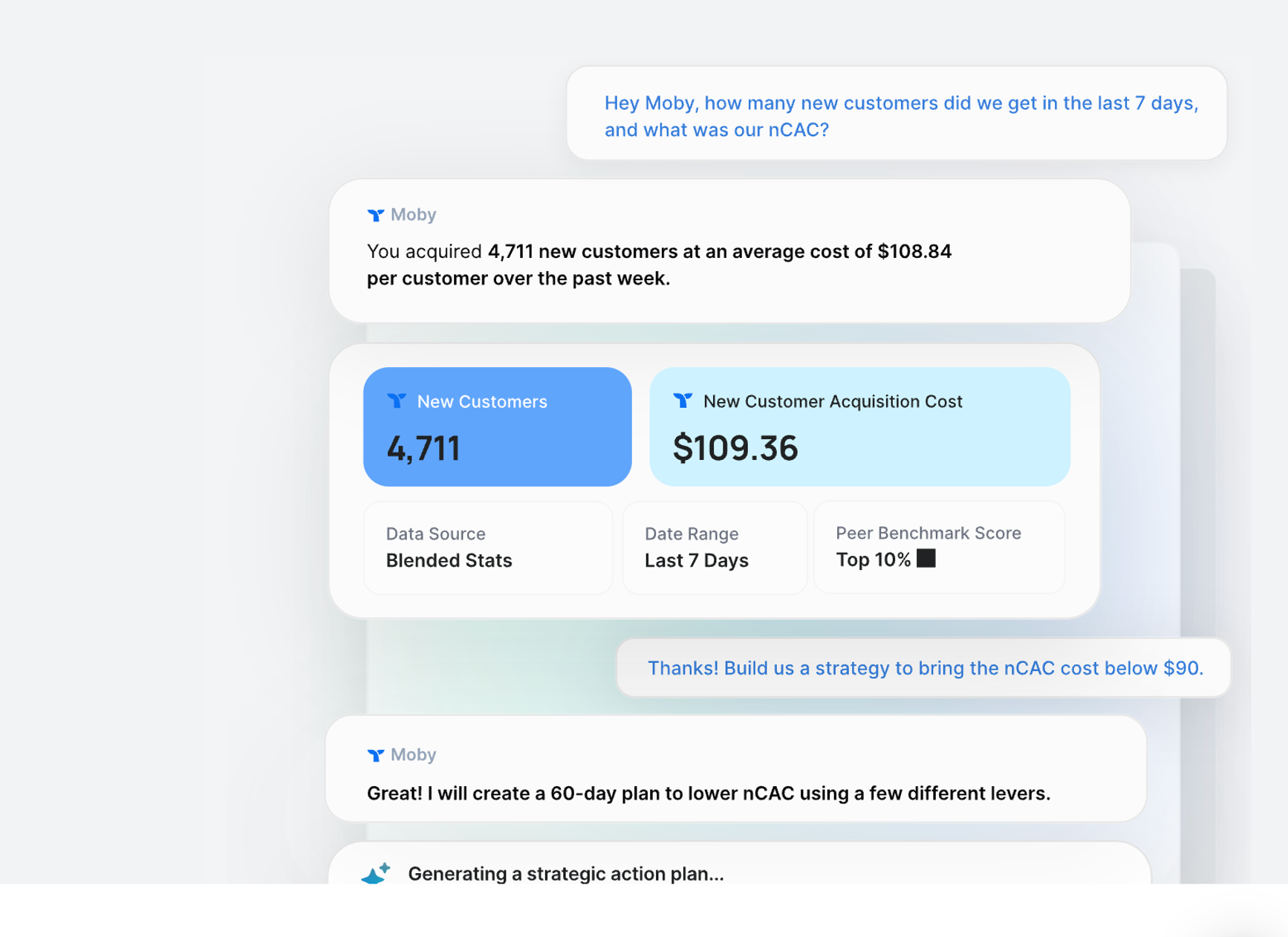
Moby already knows. Thanks to the Context Engine, Moby understands ecommerce-specific semantics, like ROAS and MER.
Without that, you’re making decisions based upon LLMs that don’t understand the full picture. A decision made without:
- Your connected business data
- Your performance history
- Your campaign and channel data
- Your attribution and measurement setup
- Your saved goals and preferences
…is just a guess.
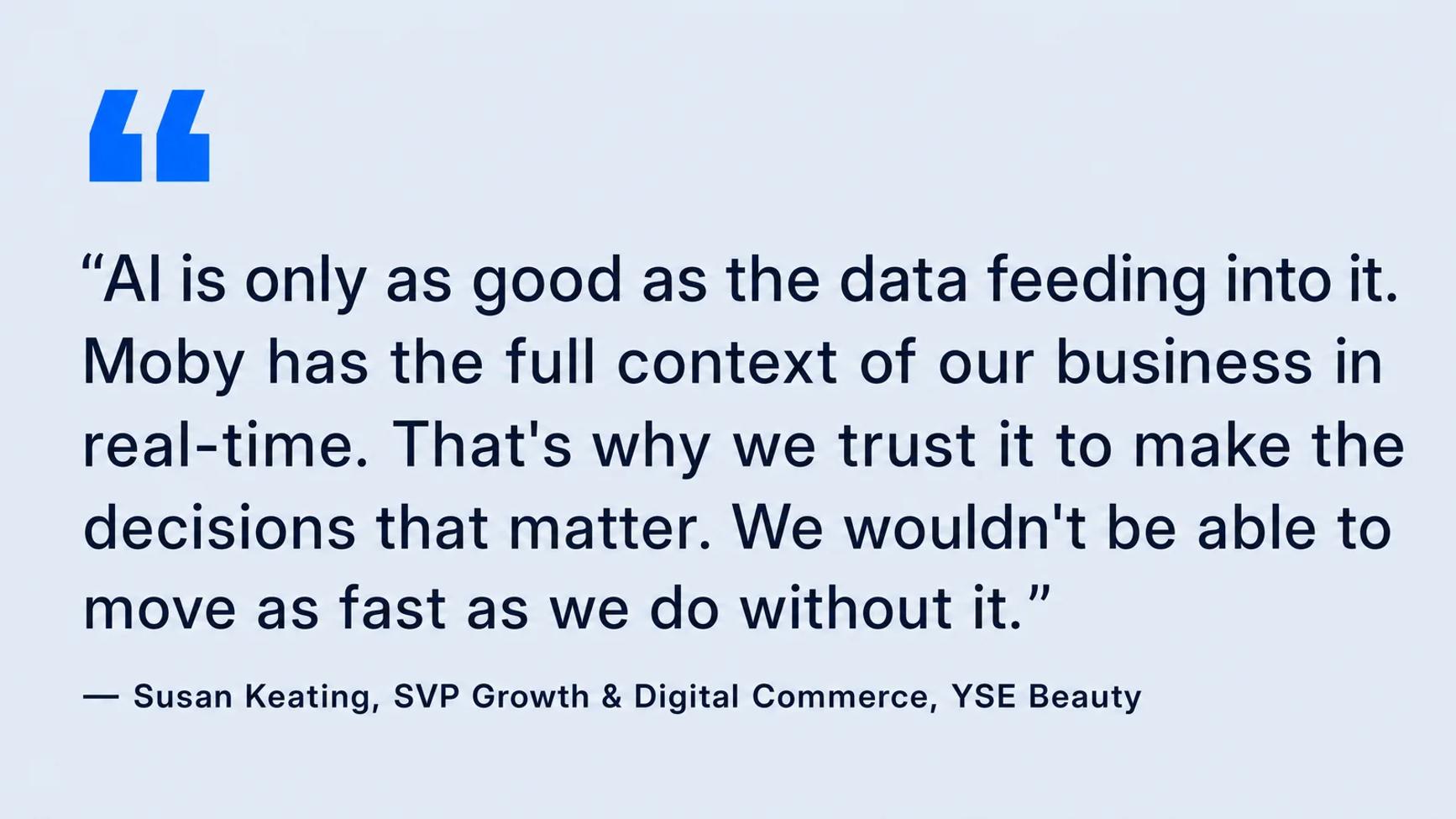
Plus, it’s constantly improving through a learning loop across 60,000+ brands and $82B+ in GMV. The more brands that use it, the smarter it gets for everyone. You’re welcome.
Moby can move from an answer to an action
Ok, so you get the trustworthy answers and benchmark-backed reports. Where do you go from there?
Automations are the easiest way to let AI do the work for you. Moby can run automation and wait for your sign-off, or run it automatically, such as:
| Title | Description |
|---|---|
| Media Buying | Manage Meta ads, optimize for ROAS, adjust bids in real time as performance shifts. |
| Email Campaigns | Build and send a full Klaviyo campaign, then monitor results and trigger follow-ups automatically. |
| Inventory Forecasting | Forecast inventory across your catalog, flag what needs restocking, and help place the PO. |
| Creative Generation | Analyze top creatives, generate new variants, launch them, and feed performance back automatically. |
| Segment Building | Build customer segments, sync to any ad platform, and continuously refine based on performance. |
| Landing Page Builds | Create landing pages that get deployed immediately to Shopify. |
Can't you just add connectors or MCPs to a generic AI tool and run automations?
Technically, yes. An MCP connector gives ChatGPT or Claude a pipe into your ad platform, but a pipe isn't a data layer, measurement layer, or context engine.
Connect Meta and Google the same way, and you get two pipes carrying two different stories with no reconciliation between them.
The model can only pass along what each source claims. It can't tell you which one is closer to the truth, because neither pipe was built to answer that question.
Triple Whale's warehouse already did that reconciliation before Moby ever answers. Triple Pixel, Triple Whale's tracking pixel, captures what actually happened on your store.
Compass, Triple Whale's unified measurement platform, matches that against what Meta and Google separately claim, so double-counted conversions and mismatched last-click credit get resolved before the number reaches you. This way, Triple Whale tells you exactly what’s working.
Can I just upload performance CSVs and spreadsheets?
Yup, that’s a common workaround. However, the second you paste a screenshot of yesterday's dashboard, it's a record of yesterday.
Claude can read it, summarize it, and reason about it well. What it can't do is go check whether that number has moved since, cross-reference it against your inventory levels, or catch that the screenshot itself came from a report with a known attribution gap.
Multiply that across a week of morning briefs, with fifteen people pasting in their own spreadsheets that represent a snapshot of different moments in time from different sources of truth, gets messy fast.
On top of that, generic LLMs provide zero governance, role-based access controls, or collaboration capabilities that modern commerce teams truly require.
There’s a better way.
Got it. How does that business context actually change the answer?
Same model, different answer, because the inputs are different. Ask ChatGPT to flag underperforming campaigns and it'll ask you what "underperforming" means, then wait for you to paste the numbers.
Ask Moby the same question, and it already knows your target ROAS, already has this morning's spend, and already knows which of those campaigns it flagged last week so it can tell you if the problem is new or ongoing. The reasoning engine is comparable.
Even further, Moby understands what ads yielded the best ROAS, which campaigns led to the highest AOV, and so much more.
That's the whole idea behind Moby Chat: The same quick-question habit you already have with ChatGPT or Claude, built on the knowledge it needs to help you grow your business.
And all you have to do is ask.
Wherever you're starting from, switching costs nothing
Here's the part that surprises people: you don't have to choose. Triple Whale's Moby is built on the same frontier models you're already using in ChatGPT (plus Claude and Gemini) with your real-time business data and context layered on top.
Barely using AI yet? Skip the setup entirely. Try the free Triple Whale dashboard and start chatting with Moby.
Already a ChatGPT or Claude power user? Nothing you built gets left behind. Importing your context and memory only takes a few clicks, and you’re ready to get started at Triple Whale.
LLMs vs Triple Whale FAQ
What's the difference between Moby and general AI tools like Claude or ChatGPT?
Generic AI LLMs are powerful general-purpose assistants, but they typically start without your full business context. Your team has to upload reports, explain metric definitions, reconcile conflicting numbers, and keep supplying fresh data.
Moby is built for ecommerce and works directly from Triple Whale’s connected data, a context engine, and measurement layer. Before the AI reasons, Triple Whale brings together your store, marketing, customer, attribution, and profitability data, and reconciles the metrics your team uses to make decisions.
What are automations?
Recurring workflows Moby runs for you: set objectives, cadence, and permissions. Moby executes while you retain control.
Can I use ChatGPT and Triple Whale together?
Yes, you don’t have to choose. With Triple Whale, Moby gives you access to the latest supported OpenAI models, alongside other leading AI models, directly within your ecommerce workflows.
You get the intelligence and creative flexibility you expect from ChatGPT, combined with Triple Whale’s live business context, reconciled measurement, and ability to analyze performance and take governed action. No constant exporting, uploading, or switching between tools.
Is Moby just Claude or ChatGPT with a different name?
No. Moby harnesses frontier models in a Context Engine (ecommerce semantics), a reconciled data warehouse ($82B+ GMV, 60K+ brands), and execution integrations. Removing that layer yields a generic chatbot.